
Anchor a note to an address
Start with the numeric address, then the displayed role and exact announcement. If a role is later arrested, killed or otherwise changes its display, your note should still explain what you heard before the change. For a time-sensitive clue, add the hour or a clear “before/after” event.
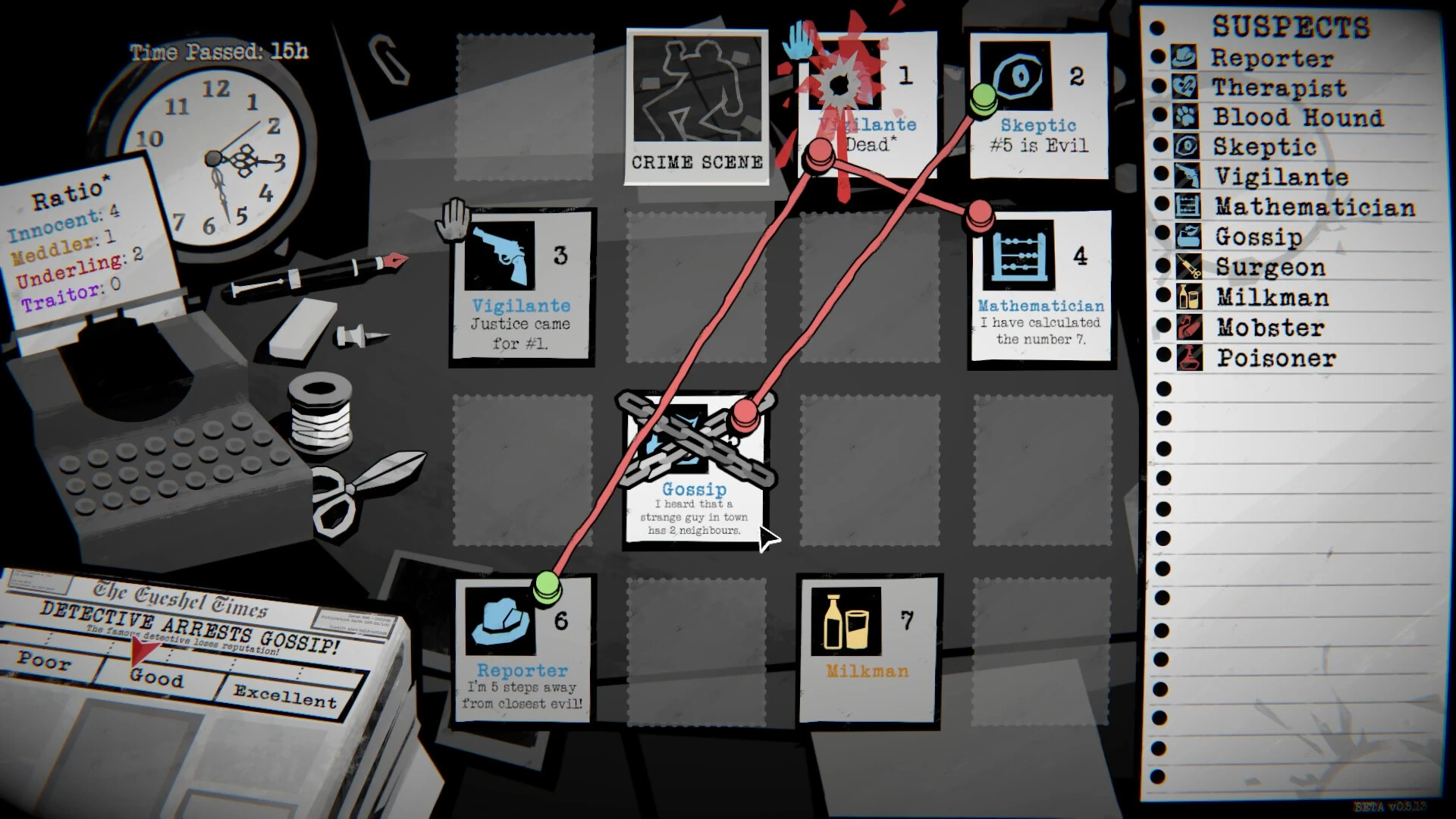
The official tool set includes a pen, an erasing tool, pins, strings and scissors. Use the controls shown in your installed version; this page does not rely on older mouse bindings. The important habit is preserving the distinction between the game’s announcement and your annotation.
Use line style as well as color
A small, consistent legend is easier to read than a different color for every theory. Here is one suggested convention: a solid relation records what a statement directly says; a dashed relation records a possibility you are testing; a crossed relation records an elimination with a reason. Label the relation’s meaning rather than assuming “connected” always means “same alignment.”
A question mark is often more honest than an alignment color. For example, “possible Drunkard” tells you why a displayed sum is uncertain; a bare red pin may hide that distinction.
Keep the reasoning dependency visible
Suppose you exclude address 1 because of a statement from address 4. Write both the exclusion and the condition: “exclude 1 if #4’s statement is reliable.” If #4 turns out to be an unreliable disguise, undo that exclusion before using the calculator again.
Avoid treating several results downstream of one clue as separate corroboration. They inherit the same uncertainty. Keep an independent second reason beside a conclusion if one exists.
Save old information before a change
Time-dependent effects make “what did it say?” and “when did it say it?” equally useful. Milkman’s Demo rule changes alignment after the twenty-fourth hour. A clue obtained before that change and another obtained after it can disagree without proving a liar.
Your compact note can be: “#7 displayed Milkman; clue A at hour 20; alignment question still current?” Distinguish an earlier announcement from a current claim. When a state changes, update the current state rather than rewriting history.
Once a contradiction is resolved, keep only the notes that help the next decision. The board is a reasoning aid; it does not need to preserve every abandoned theory in equal visual weight.